There is a lot to talk about so let’s get talking.
Zoning Analysis
Newfoundland and Labrador has three distinctive places one can find themselves. One is the great outdoors, which occupies most of the province and is mostly untouched. The second are the places we like to be: The cores of our towns, the old main streets, the quite fishing towns.
The third place is the suburban post 1960 developments. Everywhere has them; Gander, Lab City, St. John’s, and pretty much all of Mount Pearl. They are sterile, bland, dissolve the sense of community, and are also a net negative to the overall health of our towns.

Zoning is the key concept to which the entirety of our built environment revolves. We can perform most analysis on our built environment through the lens of Zoning. This could show the differences in municipal income, carbon footprint, preferred mode of transport, traffic generation and more. When we looking at our built environment from the lens of zoning, certain trends become apparent.

Active Transport Re-imagined
When looking at the City of St. John’s cycling plan, one can see how it misses the mark, is taking so long to build out as not to even be usable until 2030, and completely disregards traffic calming, or protected cycling lanes. If you wouldn’t let a 5 year old ride it, it isn’t useful infrastructure. We can do better via completely rewriting the specs.
St. John’s isn’t all there is, either. We will be looking at what makes a good active transport space in other parts of the world, what are new novel ideas, and how our Newfoundland and Labrador municipalities can build them without breaking the bank or traffic. Many of our communities are perfect for active transport to become the norm.
Transit that can work for all places
St. John’s is a city for the car. So is Corner Brook, Goose Bay, and Gander. It wasn’t always like that. Before the 1940’s our towns were for walking. St. John’s had streetcars and our fishing communities were built around the plant. Then we tore it all up and paved it. The only option for ~80% of the Province is own a car, and without it mobility is greatly reduced.
However, with a robust expansion of our transit system, to be frequent, reliable, and predictable, we could allow many people to ditch vehicles and save money, while ensuring we reduce our dependency on fossil fuelled material wasting personal vehicles. This isn’t just a big city thing either. We can show how even our small towns can band together to provide options for the citizens to get active, save money, and grow our economy.

We will explore inter-community transit to most of the Provinces towns, and intra-community transit like Metrobus Transit and Corner Brook Transit. Could smaller towns support a basic transit system or band several together to get a regional system up and running? What would that cost and look like? How do we prioritize where bus routes go? Can we re-evaluate Metrobus Transit to make it a better overall experience? We hope to explore many of these topics as we continue to expand.

Urban renewal concepts
NL has had many projects over the years, but nothing was as big as the downtown pedestrian mall in St. John’s. That is an example of a resounding success. Like many places in Canada, we did it during a pandemic. It was a resounding success in year one followed by another in year two, with the addition of some portions of Duckworth with some minor complaints. It is still a ‘setting’ and not a place. Instead of reducing the scope and making it complex, let’s embrace a full re-imagining of an accessible, car free core, with reduced traffic all around our precious historic core.
Critical Highways
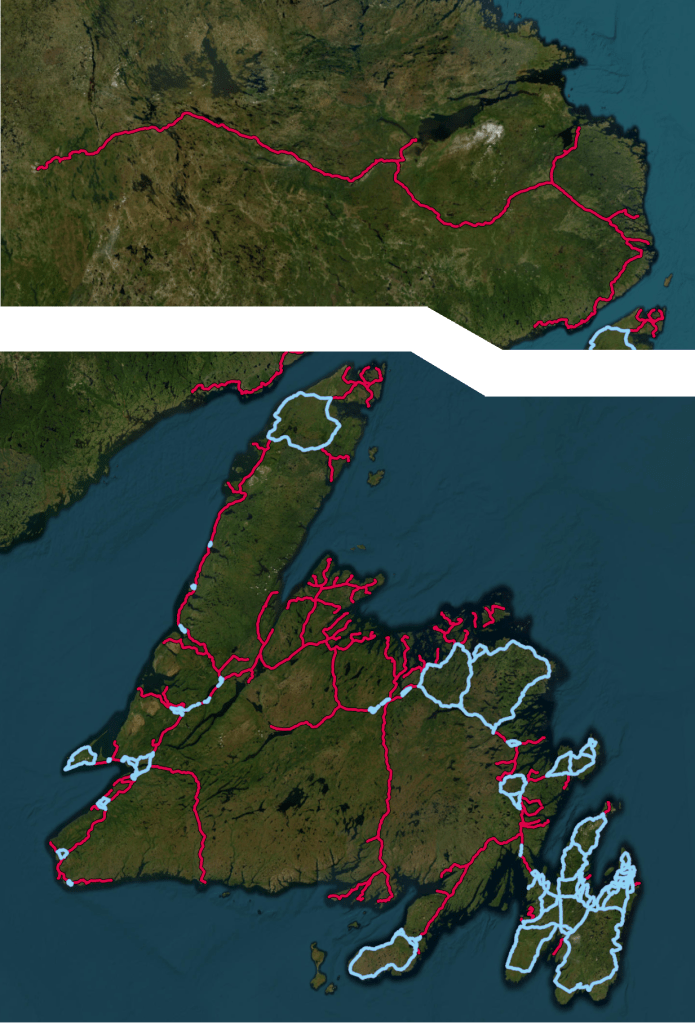
Unlike the rest of Canada, Newfoundland and Labrador has a serious issue the majority of highways being the only way around the Province and between communities. As climate change allows for far more intense compact rainfall events to occur, the likelihood of washouts impacting a segment of highway that is the only route, increases. Nearly every year some segment of the province is cut off for many days at a time. These highlighted routes are all critical and make up 75% of our highways.
Our government is deadset of spending 1.6 billion dollars twinning roads that are not at capacity. They will spend money repairing damage from studded tyres and heavy axle loading.
What if there were alternatives to the status quo that we can show and explain.
 streetsafp.ca