There are many things engineers and designers can do to make our roads safer. They can narrow the roads down like at the Kellys Brook trail crossing on Newtown Road. They can add in curb extensions like at Cavendish Square and all over Water Street. They can make roads one way like all throughout downtown and Georgetown. But the go-to for St. John’s is the speed bump. From Ladysmith Drive, to Carrick, to Viscount, to Pine Bud. St. John’s doesn’t have many but they do exist.

I want to actually keep this post short so I’ll get to the point. The point of a speed bump is change the grade or angle of the road in an abrupt way to force cars to slow down, else risk damage. If they are per-fabricated plastic or rubber, they look like the speed cushion’s on Ladysmith (image above). Speed bumps have one major benefit over other traffic calming: they are cheap as chips. Cities love them because they cost very little to install and achieve the goal of slowing cars down at a specific location. Speed bumps are better than nothing so I’ll credit St. John’s for having at least some speed bumps. They are cost effective at some speed reduction benefit.
But there are issues if they are built improperly. If a speed bump is a bolt on unit, heavy vehicles can tear them out of the asphalt and damage the road (See Clinch Crescent in 2024). If they are too tall cars can bottom out and get very damaged from them (see Clinch Crescent in 2025). If they are only across part of the road, people swerve around them and continue at speed (still see Clinch Crescent in 2025). Additionally they can create a lot of engine noise as larger and performance cars accelerate back to higher speeds between bumps and they impact someone called ‘perceived speed’ which is another post discussion point; tldr, people drive as fast as they think they can and speed bumps interrupt that and create anger.
So speed bumps negatively impact cars, don’t benefit other street users, they can generate more noise from accelerating combustion vehicles, they can damage vehicles, and some even need to be removed in the winter when road safety is even more critical. Surely there must be a better way?
The Raised Crosswalk
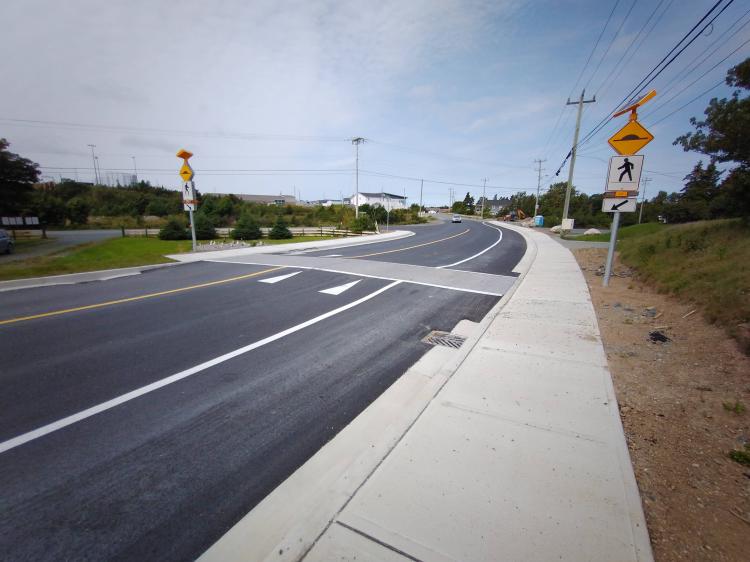
We are starting to see projects in St. John’s and the North East Avalon install raised crosswalks. You can find a few in CBS on Lawrence Pond Road, Fowlers Road, and a new one on Minerals Road (See Image). Logy Bay-Middle Cove-Outer Cove has a couple around the school. Paradise put one in on Karwood Drive. I am unaware of Mount Pearl, Portugal Cove-St. Phillips, or any other smaller regional town having any at all but I just may not be aware.
St. John’s only has a half dozen or so that I am aware of but they are diverse enough to talk about what they are for and how amazing they are! 🤩

This was one of the first in the city that I am aware of. It may have been one of the first in Newfoundland and Labrador (no source to cite) with the initial version being from around 2012 (though it was a bolt on temporary speed table back then). Let’s look at why this is just a better solution for speed control:
- Cannot be avoided as the unit extends from curb to curb so large vehicles cannot ‘dodge’ them
- Have less abrupt grades as they are usually longer than a car
- Are easy to snow clear as they are a continuous piece of asphalt (though some are concrete)
- Are permanent infrastructure as they are simply the road raised
- Provide a safe crossing for pedestrians which naturally slow cars down at the point of conflict
- Can still damage cars that speed excessively.
The last point is very important. Raised crosswalks can be designed in a way to be very damaging for vehicles speeding but be barely noticeable at 20-25km/h. I don’t want to bore you with physics and math but Newton’s laws are the reason. If you go fast, the time is far shorter to and thus a higher force to avoid change in grade (suspension is sad).
I’ll finish this post with two (three?) different types on the same road: Bonaventure Avenue. Each is subsequently more expensive to install but better for pedestrians and accessibility.

This is the cheapest to install as it requires no underground piping. When the curb and gutter on the side of the road is continuous, water can move by the raised crosswalks freely. The downside is in the winter and during rain, pedestrians have to cross water and it also has many grade changes making this the least effective for those with mobility accessibility needs. Note that just a regular crosswalk has the same issues but doesn’t slow down cars so this is still a great option.
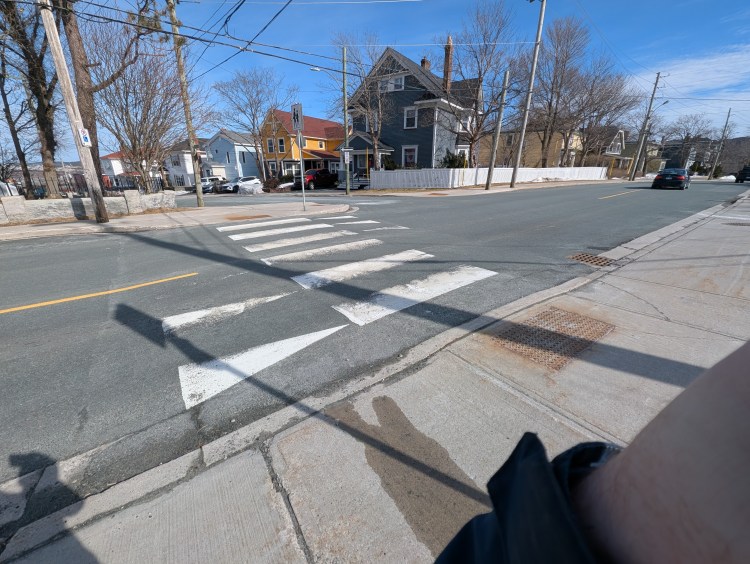
This version is not really a type, but is more a retrofit of an existing crosswalk. A crosswalk that is not raised will require curb drops for accessibility reasons. In some locations, there might be a situation where only a single catch basin is required to interrupt the flow of water along a curb and gutter which is what we see hear. You will notice that the asphalt was simply paved over the concrete gutter and a single catch basin (new) was installed on the right side of the image to collect the water. In this situation, the road side closest to us was raised slightly when the tactile plate was installed and to make the raised crosswalk easier to use. This has less grade changes for pedestrians and is cheaper to install than a full continuous crosswalk.

This type of raised crosswalk is another retrofit and is almost a full continuous crosswalk. They do require the road to often have 2 additional underground catch basins (the grates water go into) to be installed which costs about 4 houses taxes per year) but results in a fully continuous crosswalk so pedestrians do not have to change ‘grade’ to drop down to the road level. In this situation, the City didn’t fully fix the sidewalk on the road side the image was taken from, but the other side is perfect. They sidewalk remains 150mm above the road, with a traction plate, new catch basin, and the crosswalk is at the height of the sidewalk. 10/10.
The crème de la crème would be if both sides were like the opposite site, and one could argue that having a concrete surface looks more premium but there are issues with having concrete decks on the raised crosswalks. Plowing, thermal shift, freeze thaw penetration, slip, higher impact, etc. They ‘look’ better from a drivers perspective but I’m a pragmatist so using only asphalt is cheaper, easier to maintain, and ‘softer’ to use so it is my personal choice.
Short Conclusion
Continuous grade crosswalks are a very cost effective way to make streets safer for people (Boo-ya I got it in there 😝), while impacting drivers in the least impactful way. It helps maintain a sense that pedestrian safety is paramount. Most importantly, they are amazing for our very snowy climate, barely impacting snow clearing operations. We love continuous grade crosswalks!
 streetsafp.ca